
ON LOVE, PLAINLY
Burke and Laclos and Love as Tenderness, and Power

My tulips died today. Parched, apparently. Also, quite symbolic, for a day defined by love (everything that keeps you alive might also be the reason a part of you dies). I slashed through the red petals with my sharpest set of scissors and [CENSORED] went to get me blue and white hyacinths. Before, I refused flowers. They were gorgeous for a while, but that knowledge that they would perish eventually made me feel sick of admiring their temporary beauty. Now, I do not even flinch. In fact, I endorse the inevitability of violent death. Love is more than just red. Love is more than just blood.
Love is odd, actually. Whether subconsciously or not, the whole ordeal is more about ourselves than it ever is about our lover. Why?
Well. For starters, there is always, sooner or later, a destruction of the imaginary fine line that stabilises mutuality (I will get philosophical here, you have been warned). You cannot be both the self and the other, despite the many roles you might perform. Everything must be contained within the beholder or the cynosure, but never both. Perhaps we might begin with the exploration of love in literary fiction, for it grazes the boundary of the abstract more than it does the reality. But first, I must clarify that a feeling is never right or wrong - it simply is. Subjective emotion is far too complex for any sort of categorisation or rule-definition. But others have attempted such a challenge, and therefore what is stopping me from conducting a cynical study of the texts I have most recently consumed? What is love supposed to be, and why does love in reality have almost nothing in common with its true definition?
Love is supposed to be patient, selfless, soothing, all that good stuff. But more often than not it is angry, tedious, self-serving, and tires out the affection of the individual sooner than its apparent lifespan. Love, or discussions surrounding love, typically occupies two camps of philosophical/aesthetic camps, which are, simplified, rationality and irrationality, reason and emotion. I am focusing, here, on frameworks of rationality that give way to romantic aspects, because both of the guts of these ideas slip into each other anyway, and perhaps it is symbolic to highlight how even the most controlled individual might be destabilised. Even orderly things bleed. Everything eats its own red.
Philosophies of love have allowed me to declare that love rarely ever is absent of power dynamics (even the most honest ones), because love, by its nature, is not selfless when it is formed or created by inherently non-selfless beings (us). For love to be sustained and continuous, it must be equal, but elements such as the desire to maintain obscurity and to postpone vulnerability, as well as the typical need for a self and other, beholder and cynosure dynamic, leads to a destabilisation of what has previously worked so well when we attempt to challenge it. That is not to say that common roles cannot or should not be fulfilled, because they are helpful and tend to provide guidance at a crossroads, but if they are too strictly adhered to, and do not allow for balance, when those roles fluctuate or allow room for more than limitation, the equality on which that relationship is built on also destabilises.
I’ll start with Burke. He’ll make more sense than I do.
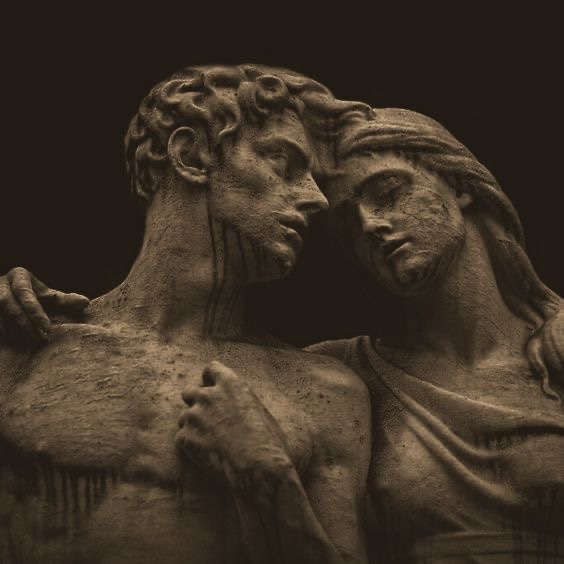
Though Burke perhaps wasn’t the greatest guy to ever exist (debatable), he also wasn’t an unwise one. His ideas in A Philosophical Enquiry into the Sublime and Beautiful serve as the basis for how we view, receive, or perform love. In his quite orderly, categorised-by-sections enquiry, Burke argued that love is characterised by soft feelings of tenderness and affection, due to its ability to “calm our nerves” and therefore encourage pleasure. Love is the pleasure that arises when beholding beauty, which is instinctual and therefore does not require reasoning or conscious thought. This is not to be confused with desire, which may arise for an object or individual outside the bounds of what we consider to be beautiful. Now, I have only a slight issue with this.
Another one of Burke’s key ideas which shaped the concepts that would follow them, was the sublime, which is associated with feelings of pain, terror, and awe. The sublime opposes love because it excites our passion rather than calms it (which is not to say that we prefer feelings of pleasure to pain, but that is another matter). Why I have an issue with this is my own extension of Burke’s definition of love, which he no doubt deems as positive, and it begins with this statement: “we submit to what we admire, but we love what submits to us.” This already destabilises the balance of love as mutual selflessness and presents it as a pleasure derived from the object of our affections remaining in a position of inferiority. I state, as a subjective interpretation but not without an objective foundation, that with sublimity, we feel admiration and awe for what is greater than us, what we cannot touch or what is beyond the limits of our comprehension (like God), which is hugely enabled by obscurity. With love, what we consider beautiful we consider weak, and therefore non-threatening. In fact, Burke goes as far as to connect weakness and tenderness to women, which adds an element of gender prejudice to this aesthetic instability: “women are very sensible of this… they learn to counterfeit weakness, and even sickness…beauty in distress is much the most affecting beauty.” We are most affected by vulnerability due to our ability to exercise the role of superior protector (typically occupied by men), and therefore the observer (also typically men) might be relaxed while the admired (typically women) might be made smaller.
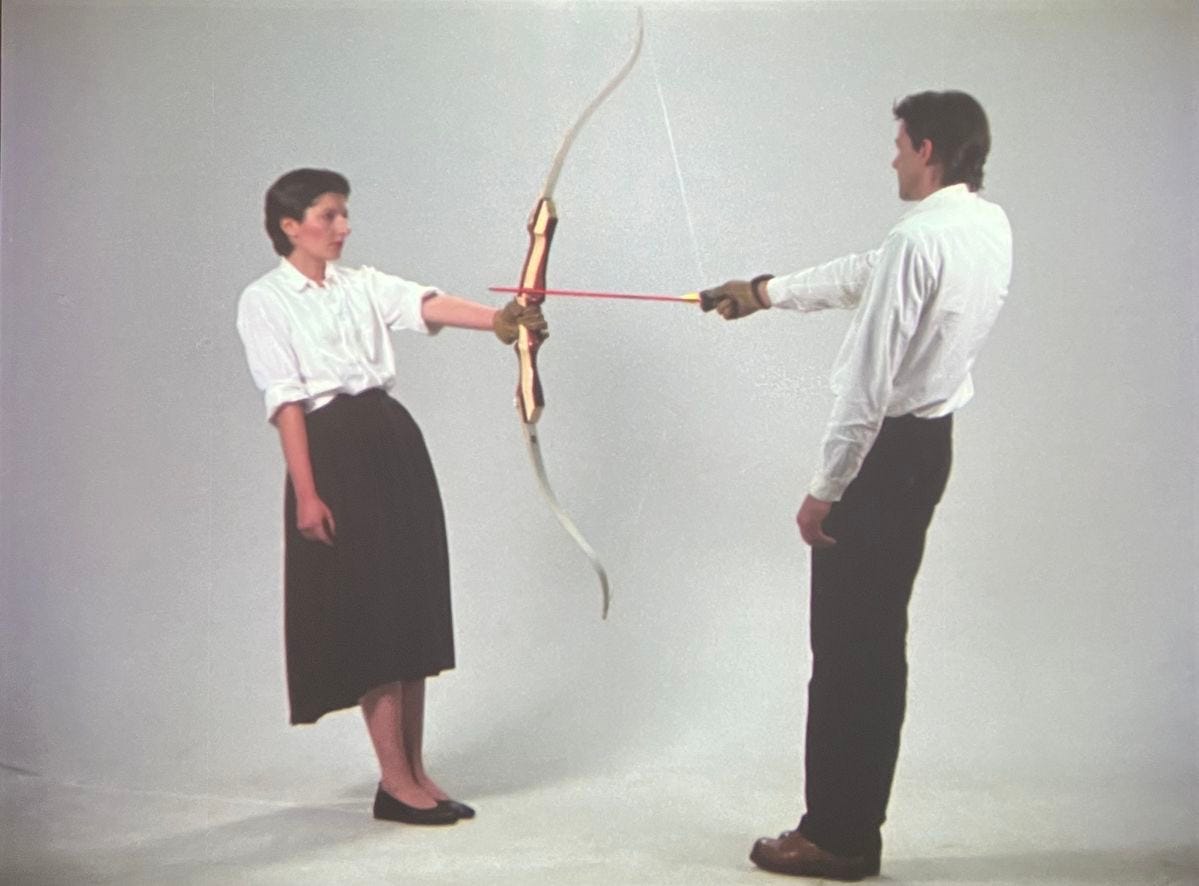
Burke makes it clear that his ideas on the sublime and the beautiful stand on different foundations. But I challenge it (how well it is done is also another matte). I mean, it is ‘26, and we operate, or hope to operate, on another level of analysis. I do not intend to confuse feelings of the sublime with the love created as a result of pleasure, or to state that one is evoked by the other. Rather, I am stating that such ideas still influence the manner in which, again, we view, receive, or perform love. Love is tender only from the view of the relaxed, pleasure-filled individual, and through that we might understand (despite the sublime and the tender being separate ideas of feeling) that love from the view of the “inferior” is a feeling of awe and admiration, which challenges love as a collective or socially bonding experience - it is contained within one individual and changes when transmitted to the other. In order for love to be detached from power dynamics, there must be two cynosures, or two beholders, to meet each other on an equal level, but even then, love detached from power does not equate to a love that survives. Two individuals dominated by tenderness must succumb to vulnerability and accept a loss of control, and many individuals fear honesty and being seen for who they really are. Obscurity is naturally an idea attached to the sublime, and it has been stated that “to make any thing terrible, obscurity seems in general to be necessary.” If we apply this idea to affection, which can be related, then when someone appears to us as obscure (hidden, mysterious, not fully known), we feel towards them a sense of admiration, but when they become fully readable, interpretable, and clear, then that admiration fades into tenderness, because they cease to have an effect on us. Therefore, if both individuals were obscure, there would be a very low chance of that love surviving too, and it all stems from that loss of control, and a desire to remain untouchable and incomprehensible. Much like God. And humans cannot excite in others the fear that God excites within them.

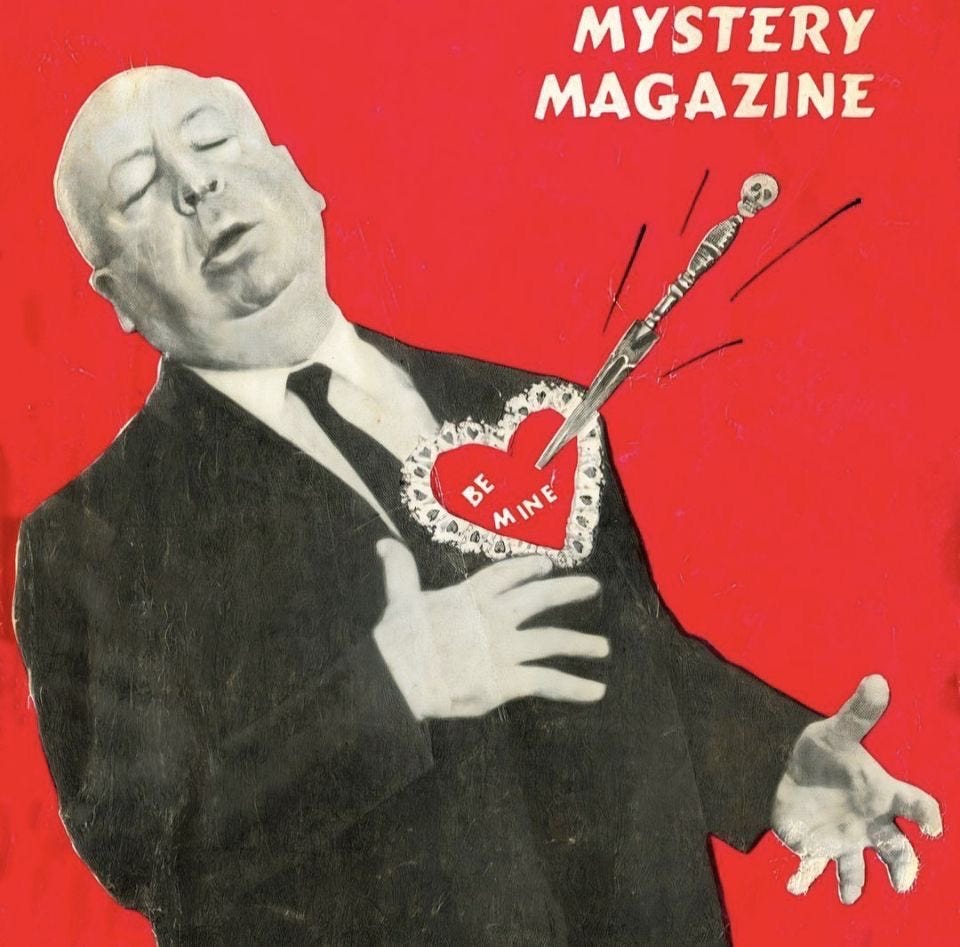
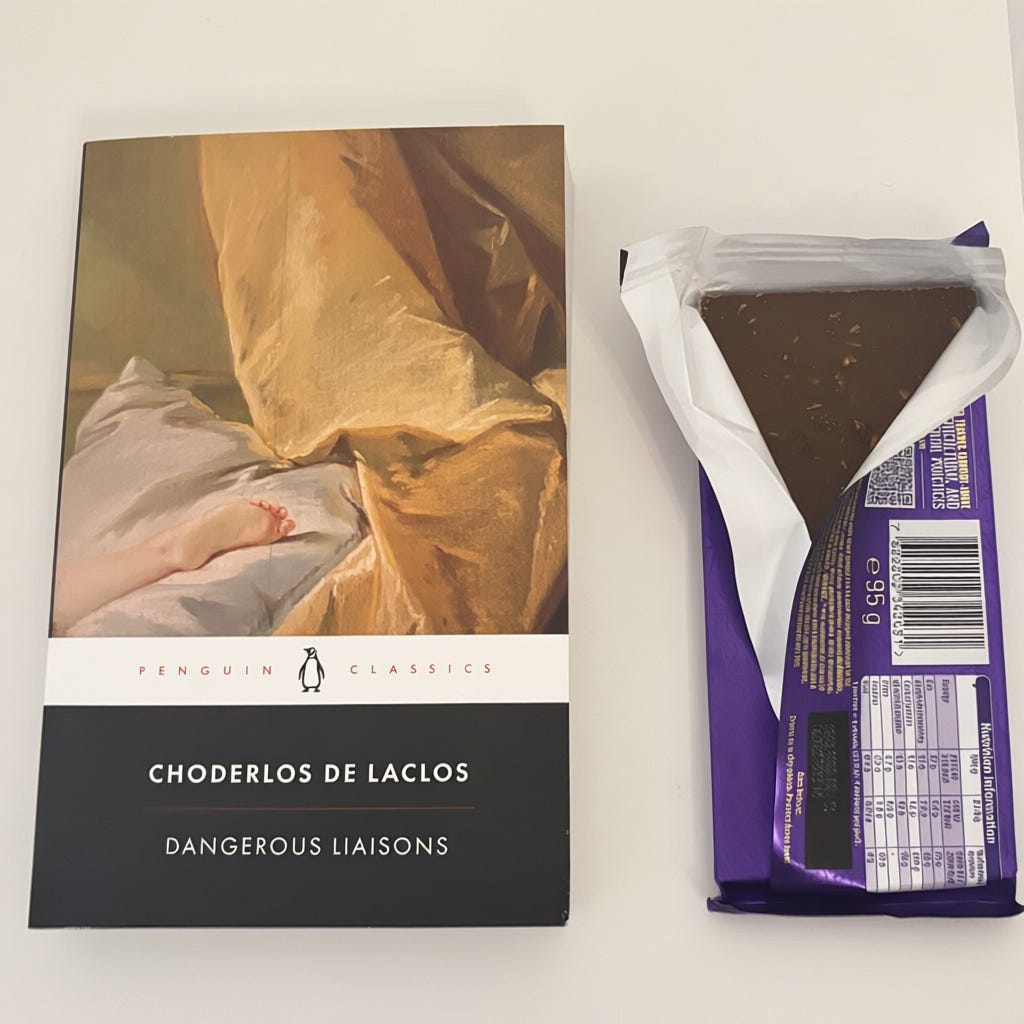
Perhaps to understand the idea of love as a power struggle, a game, a conquest, it is necessary to look beyond Burke (for his strongest arguments are not on love), and into one of the most popular works on desire and manipulation: Laclos’ Dangerous Liaisons. This novel is set in 18th century France and focuses on a French aristocrat, Merteuil, seeking revenge on a former lover by corrupting his new, quite innocent fiancée, Cécile. She recruits her ex, Valmont, to corrupt the fiancée, while Valmont sets his sights on seducing a married Tourvel. The funny thing is, these characters are much wiser than what Burke’s theories of love suggest but end up omitting (but that is because that is not the point of the enquiry, and because it categorises feelings and ideas into simpler binaries as a philosophical study, not epistolary novel). Laclos acknowledges initially that to fall in love is to sacrifice control, and power is the ultimate characteristic of the victor in the game of affections. Burke’s idea of love as tenderness and relaxation also requires one to be in a position of power, though that is not how it is typically read. In Dangerous Liaisons, the characters, especially Valmont and Tourvel, know that love is soft not because it is relaxing, but because it makes you weak - “I see you are already as timid as a slave: you might as well be in love.” They understand that once you are blinded by emotion, you become easy to read and predictable in action and feeling. While this novel acknowledges, or at least posits, that love is not a mutual exchange, and still presents feeling as victor/victim (both operate on Enlightenment values of rationality), I state that since Burke posits that the ability to feel love is to adore what submits to us, then his ideas, consciously or unconsciously, point to the necessity of being in a position of victor/protector, and since Laclos highlights love as a detachment from power, reason, and self-protection, distress is felt when one is in the position of victim/protected. While a brief “submission” to this feeling grants Valmont a sliver of real happiness (he stops playing a role and might finally be his authentic self), it ultimately leads to his downfall, and to the downfall of the rest of them too.
So, what is the point?
Love is determined by power, considering what I have established through interpretation. It should not be, but it is. It is based on hierarchy, and the ability to control or be controlled. This is undeniable. I suggested that in order for love to truly be selfless and mutual, real emotion has to be involved from both parties in a way that flattens the balance of inferior and superior. It sounds simple - many relationships appear to thrive on mutuality and a common ground, which is beautiful, and obviously not impossible. But when love is set up, from the very beginning, as a system of cynicism, as a game (not in a literal sense, but metaphorically - we all like to test each other, play truth/false, conceal things, keep secrets), then the system collapses when true emotion enters. In Valmont’s case, it leads to death. In Tourvel’s case, she dies of heartbreak and grief. In reality, when an individual, or two, is afraid of vulnerability, the inability to face truth leads to escape, and therefore a destruction of what we call a relationship. The inability to face truth also leads to continuously contained obscurity, which is when a relationship continues, but is characterised by distance and an inability to truly understand the other, and in turn, the loss of your own self. This is not daringly bold or new information, but I wished to highlight how frameworks that have been around for a good amount of time unconsciously support this idea. I am not attempting to be cynical, only honest. This does not apply to every case.
Whether we are aware of it or not, love (true, selfless love), asks us to sacrifice our dignity or pride in one way or another, and as beings who are instinctually and inherently selfish, it is difficult to get close to those you care about without being convinced that you will somehow appear inferior, or become easy to read and interpret, and therefore, liable to harm or hurt. It is easier to be the one who hurts, to be in the position of the observer, the one who holds power, or, even to remove oneself from the equation of love completely. Succumbing to real affection is a risk, but so is escaping it. The impossibility of victorious love is that no one can ever truly “trust” another in the manner they expect to, because certainty will always be impossible. We’re not mind readers. We cannot predict that the one we love will never betray or harm us beyond repair. That is not to say that it is necessarily wise to just toss yourself into the fire. Obviously. Be wise. But be careful that being wise does not lead to your own demise.
Happy Valentine’s Day, Galentine’s Day, however you celebrate it… whatever you do, remember that you are so so loved. Be kind to yourselves (and that goes for every day beyond this one).

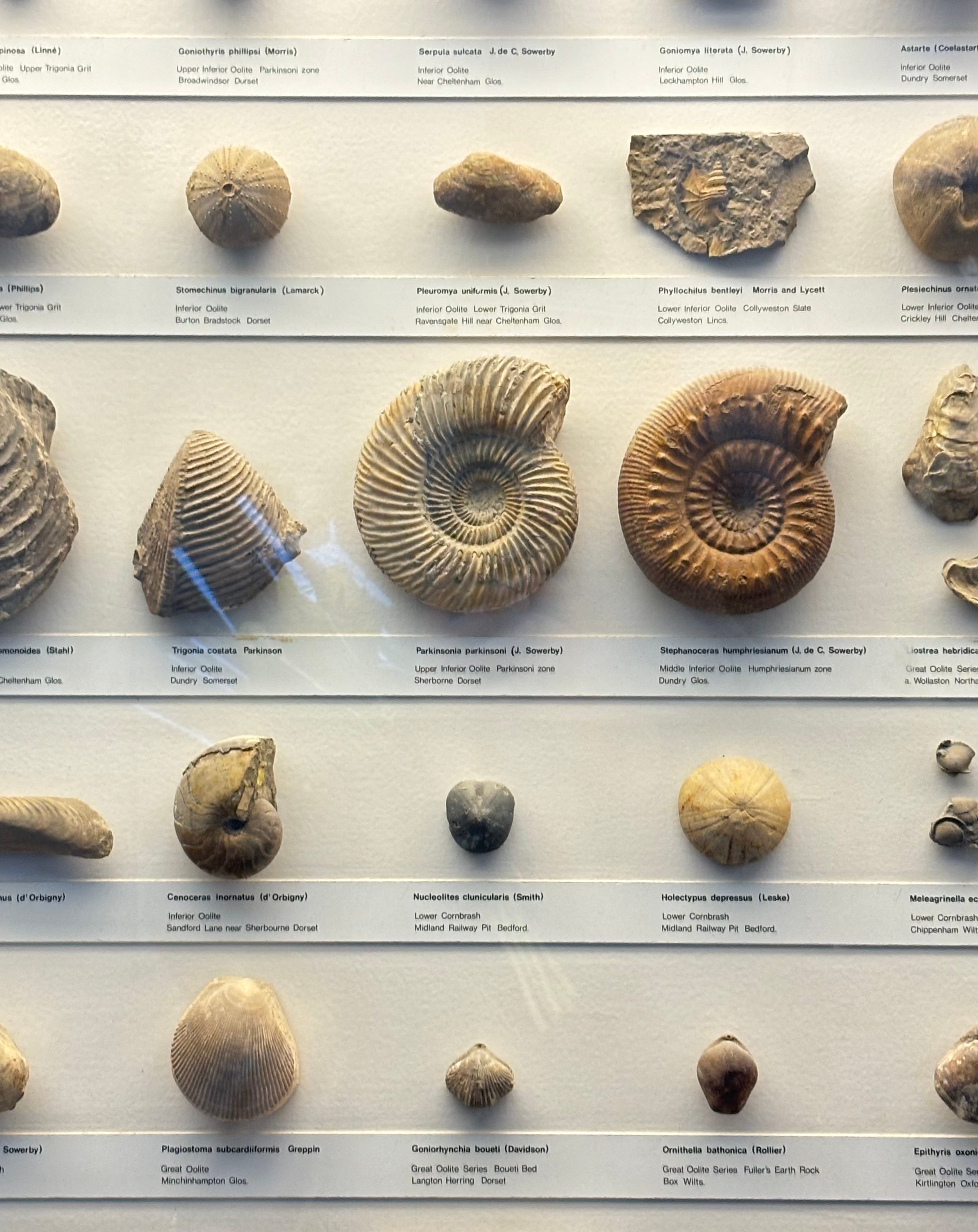
A Very Dear Friend of mine and I went to the Natural History Museum a fortnight ago, and it was obviously spectacular as always (hadn’t been since secondary school). Perhaps it is time to redefine the sublime - we were in awe looking at all of those fossils, all of that proof that something can survive across centuries while we just pass into the afterlife. That’s intimidating. That’s threatening - something that stays, that remains. It is not always rocky landscapes, uncontrollable oceans, or violent storms that unsettle the soul, but immortality that disrupts our senses of superiority.
…
Hi there, thank you so much for reading !! Find me on ig for more, if you’d like ;))
Love, Erica x
Hi, so happy we connected 🤍 I’m loving your content — I’d love for you to check out my page and subscribe if you love it too 💌 xx